AI legal research tools for Philippine law: what works, what does not, and why
The AI tools that work for Philippine law are grounded in Philippine sources and link every claim to the provision or decision it rests on, so you can check each one in the Supreme Court E-Library or the Official Gazette. GPT-4 hallucinated on 43% of legal queries in Stanford's 2024 benchmark, and US legal AI covers American law.
Updated
The map: four kinds of tools, one question
Every option for AI-assisted Philippine legal research falls into four buckets. General chatbots such as ChatGPT and Gemini. US-centric legal AI platforms such as Lexis+ AI and Westlaw AI-Assisted Research. The free authoritative sources: the Supreme Court E-Library, the Official Gazette, and long-running archives of statutes and decisions. And grounded tools that answer, with citations, from the Philippine sources you add to them, which is where Tatsulok sits.
One question sorts them: when the tool asserts something about Philippine law, can you open the exact provision or decision it relied on? Everything else, speed, interface, price, is secondary to that.
Can you use ChatGPT for Philippine legal research?
For orientation, yes. As an authority, no: check every statute and case it names against the official text.
ChatGPT and its peers know a surprising amount about Philippine law from training data, and for explaining concepts or drafting outlines they are genuinely useful.
The measured risk appears when they are used as authority. Stanford's benchmark found ungrounded GPT-4 hallucinating on 43% of legal queries. Fabricated citations have already produced court sanctions abroad, from the $5,000 fine in Mata v. Avianca onward, and the Code of Professional Responsibility and Accountability imposes the same duty of candor on Philippine lawyers. A hallucinated G.R. number in a pleading is the same breach in Manila as a fake federal case is in New York.
Do Lexis+ AI and Westlaw cover Philippine law?
Not as their core library: both are built around US primary law, not Philippine statutes, jurisprudence, and administrative issuances.
They do show what grounding buys. In the same Stanford benchmark, Lexis+ AI hallucinated on 17% of responses and Westlaw AI-Assisted Research on 33%, both below the ungrounded 43%, though both vendors' "hallucination-free" marketing was found overstated.
Enterprise pricing aimed at US firms settles the question for most Philippine practitioners, students, and businesses: better rates on the wrong library is still the wrong library.
Where can you read Philippine laws and decisions for free?
The Supreme Court E-Library has the decisions, and the Official Gazette has the statutes and issuances. Both are free and authoritative; the hard part is searching them.
Public archives add decades of decisions and codes. When you must cite, these sources are the ground truth, and no AI answer outranks them.
The gap is searchability. Finding the controlling doctrine across thousands of scanned decisions means knowing the G.R. number, guessing keywords, and reading long documents one at a time. That friction is precisely what pushes people toward a chatbot's confident summary, which is how unverified claims enter real work. The fix is not to avoid AI but to point it at this corpus directly.
Grounded Philippine research: your own sources plus citations
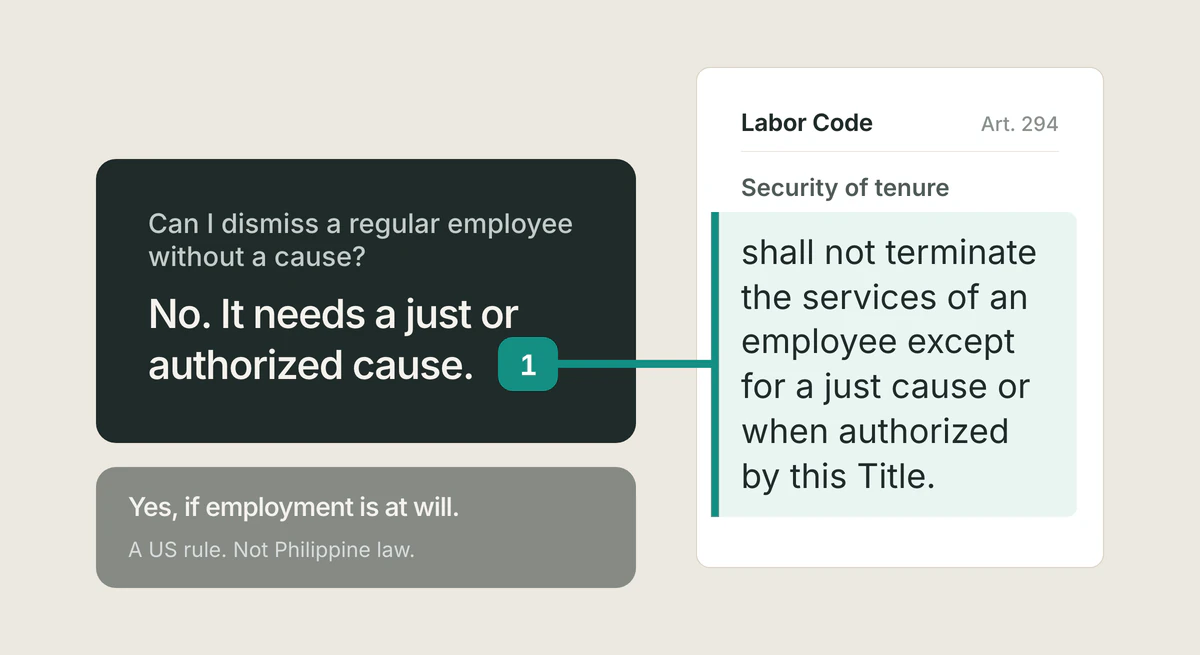
Tatsulok's approach is to make the documents you already hold conversational. The contracts, pleadings, decisions, and codal copies in your own files are indexed so you can ask a question in plain language and get an answer assembled from those sources. Every sentence links to the exact passage in the document it came from, so verification is one click, and when your files do not answer the question, it says so.
Because the corpus is yours, you decide what counts as authority: read a contract against the copy of the Labor Code you keep, or a client memo against the decisions you have collected, in one question. For the verification duty the CPRA imposes, that architecture is the difference between trusting a summary and checking a source.
FAQ
- What is the best AI tool for Philippine legal research?
- One grounded in Philippine authority with passage-level citations. Ungrounded GPT-4 hallucinated on 43% of legal queries in Stanford's benchmark, and US legal AI platforms cover American law. Tatsulok answers from the statutes, codes, and decisions you put in your own library, with every claim linked to its source.
- Can I use ChatGPT for Philippine legal research?
- For orientation and drafting, yes. As authority, no: ungrounded models hallucinate at measured double-digit rates, and courts abroad have sanctioned lawyers for unverified AI citations. Verify every statute and case against the E-Library, the Official Gazette, or a grounded corpus before relying on it.
- Do Lexis+ AI or Westlaw work for Philippine law?
- They are built around US primary law and priced for US firms. Stanford measured their hallucination rates at 17% and 33% respectively, better than ungrounded chatbots, but Philippine statutes and jurisprudence are not their corpus.
- Where do I find authoritative Philippine legal sources for free?
- The Supreme Court E-Library for jurisprudence, the Official Gazette for statutes and issuances, and public archives of codes and decisions. Tatsulok makes the sources you have gathered searchable and conversational, with answers cited to the exact provision.
- Are lawyers allowed to use AI for research in the Philippines?
- Yes, with the same duty of candor as any research method. The Code of Professional Responsibility and Accountability makes a lawyer responsible for what they sign, so every AI-supplied citation must be verified against the primary source before filing. Citation-first tools make that check take seconds.
Sources
Related guides
AI Legal Research
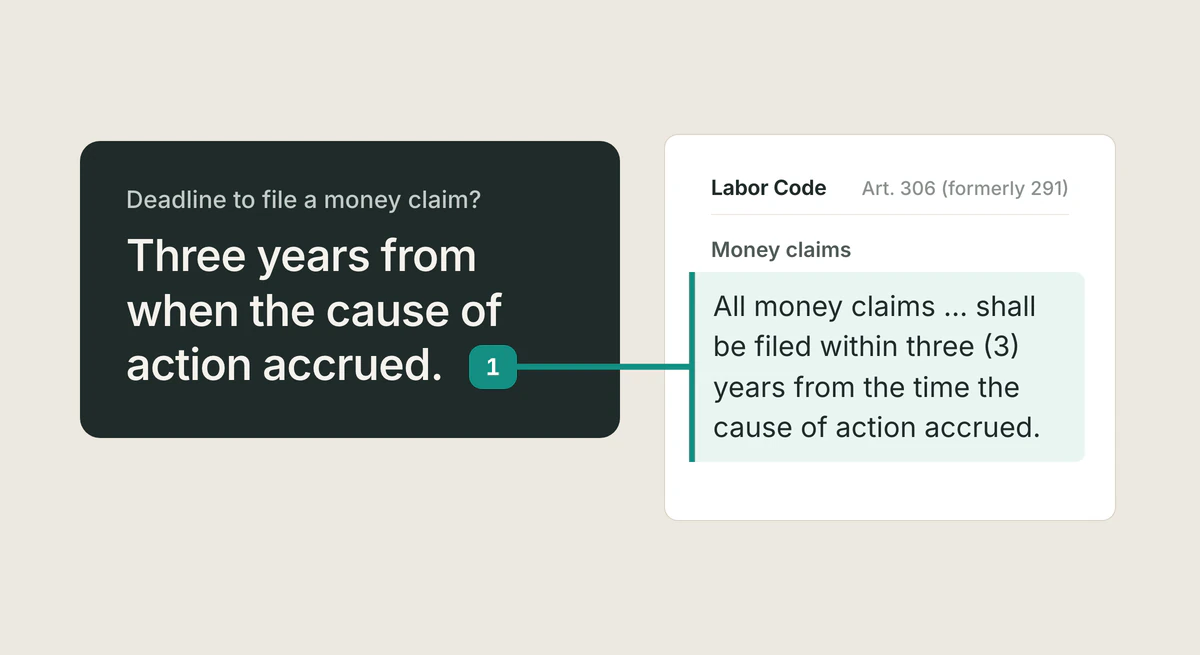
Philippine legal research with AI is reliable only when each claim is checked against an official source. Learn how to find, trace, and verify cited law.
Read the article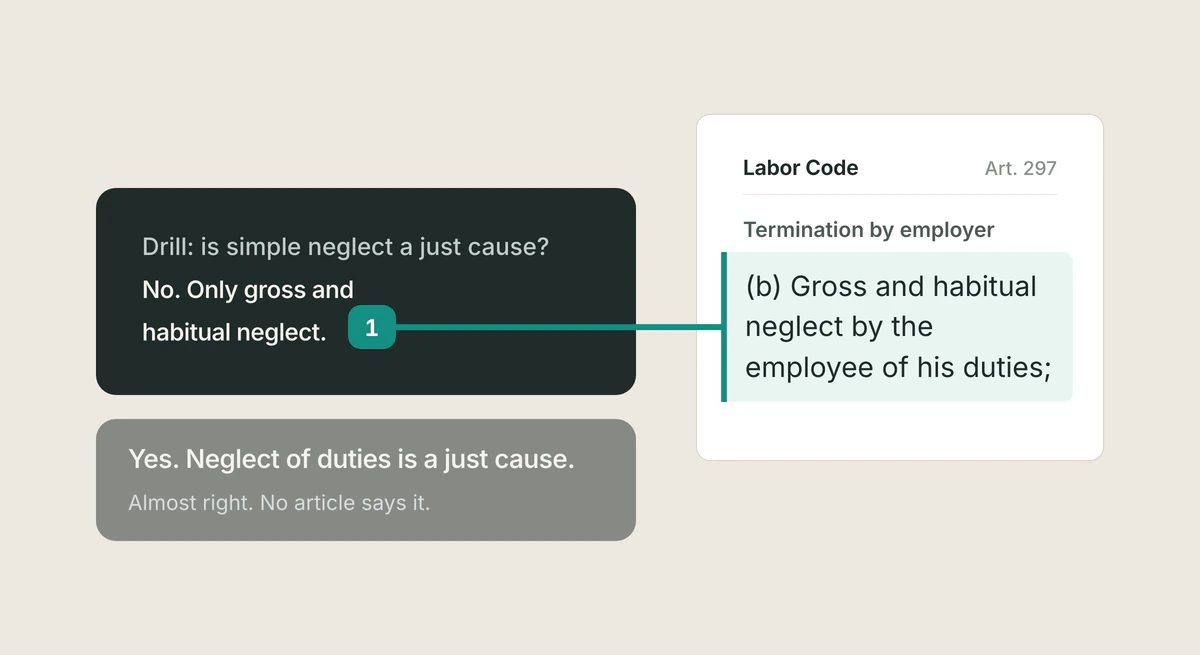
AI for bar exam study
48.98% passed the 2025 Philippine Bar. AI can genuinely help you join them, if you use it as a drill partner grounded in real law instead of a summary machine you cannot check.
Read the article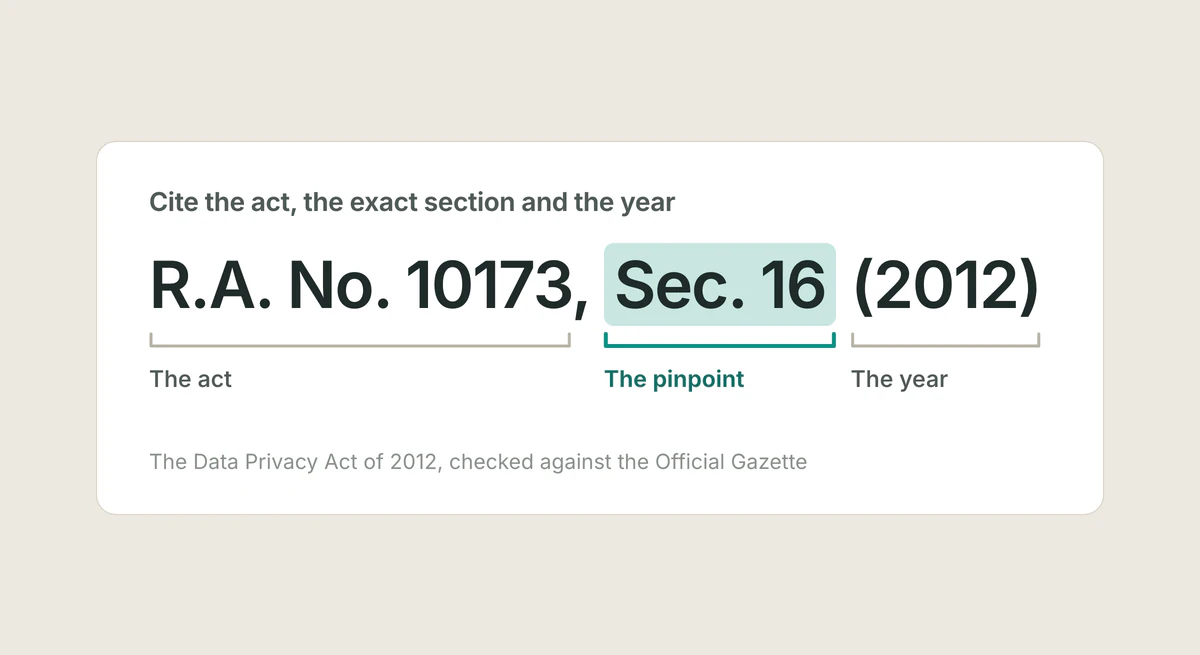
Legal Citation
Examples: Republic Act No. 10173, Sec. 16. Oposa v. Factoran, Jr., G.R. No. 101083, July 30, 1993. 1987 Constitution, Art. III, Sec. 1. Plus the APA forms.
Read the article