How to Cite Philippine Law Correctly
Cite Philippine statutes by Republic Act number, title, and year; Supreme Court decisions by case title, G.R. number, promulgation date, and reporter citation when available; and constitutional or procedural provisions by Article or Rule and Section. Add a pinpoint citation for the exact page, paragraph, or provision supporting your statement. Exact citations let readers verify both the authority and the precise legal proposition.
Updated
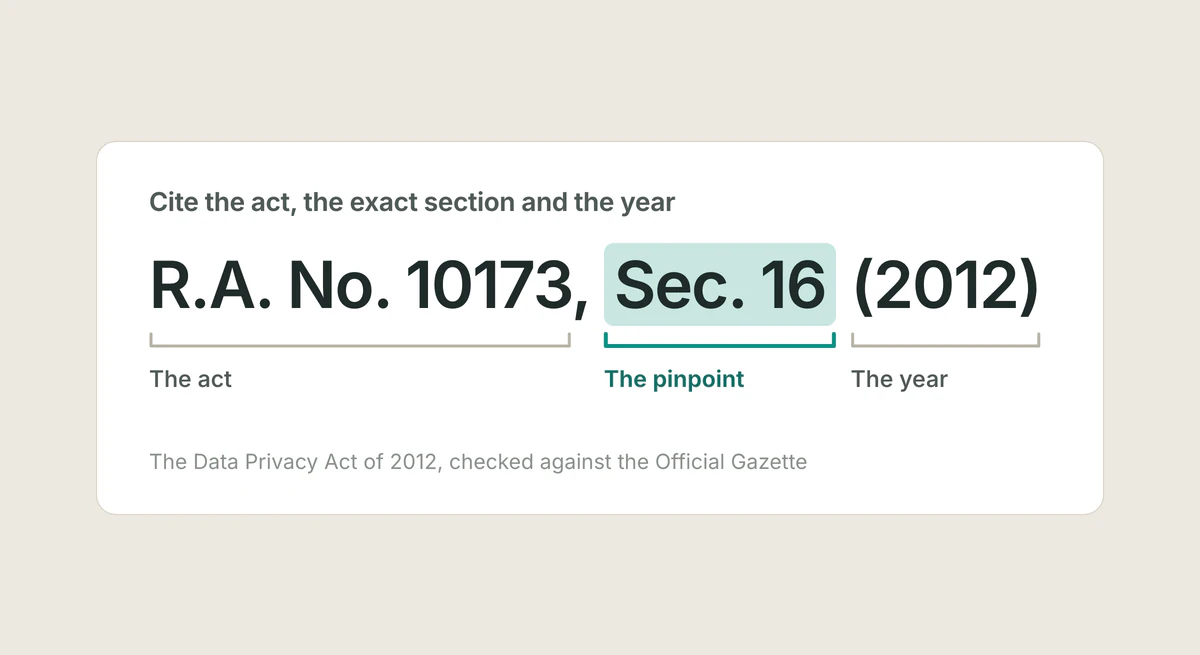
Citing Republic Acts and statutes
Cite a statute as Republic Act No. [number], commonly given with its short title. When you rely on a specific provision, add Section [number] as a pinpoint. Confirm the number, title, and text against the Official Gazette, and note the effectivity date where it matters to your point. Example: Republic Act No. 10173, the Data Privacy Act of 2012, Sec. 16.
Citing Supreme Court decisions
Give the case title, G.R. No. [number], and the promulgation date, which reliably identify a decision including recent ones not yet in a printed reporter. Where your citation style requires it, add the Philippine Reports or SCRA volume and page. Confirm the case against the Supreme Court E-Library. Example: Oposa v. Factoran, Jr., G.R. No. 101083, July 30, 1993, 224 SCRA 792.
Citing the Constitution
Name the Constitution and identify the exact Article and Section, such as Article [number], Section [number]. Include the constitutional year when needed to distinguish the current Constitution from earlier charters. Quote only the language necessary for your argument. Example: 1987 Constitution, Art. III, Sec. 1.
Citing procedural rules
Cite the Rules of Court or another named rule set by Rule [number], Section [number]. State the complete title of a special rule when its identity would otherwise be unclear. Check whether amendments have changed the provision before relying on it. Example: Rules of Court, Rule 45, Sec. 1.
Citing administrative issuances
Identify the issuing body, type of issuance, number, title when available, and date. Examples of issuance types include administrative orders, memorandum circulars, department orders, and circulars. Add the specific section, paragraph, or item that supports the proposition. Example: Department of Labor and Employment, Department Order No. 174, Series of 2017 (March 16, 2017).
Using pinpoint citations
A pinpoint directs the reader to the exact page, paragraph, section, or subsection supporting your statement. Use the document's own paragraph numbering when available; otherwise, cite the reporter or official document page. A citation to an entire authority is insufficient when only one passage establishes the point. Example: in "Republic Act No. 10173, Sec. 16", Sec. 16 is the pinpoint.
Verifying every citation
Check Supreme Court decisions against the Supreme Court E-Library and statutes, constitutional texts, and executive issuances against the Official Gazette. Compare the title, identifier, date, relevant text, amendments, and publication details. Do not rely solely on summaries, search snippets, or unofficial copies.
FAQ
- How do I cite a Philippine Supreme Court case?
- State the case title, G.R. number, and full promulgation date. Add the SCRA or Philippine Reports citation when available or required, then give the exact page or paragraph for the proposition cited. Example, before the pinpoint: Oposa v. Factoran, Jr., G.R. No. 101083, July 30, 1993, 224 SCRA 792.
- How do I cite a Republic Act?
- Use Republic Act No. [number], its short title, and the year, such as Republic Act No. 10173, the Data Privacy Act of 2012. Add Section [number] when citing a specific provision, and verify the text and enactment details in the Official Gazette.
- How do I cite the Philippine Constitution?
- Name the Constitution and provide Article [number], Section [number], such as 1987 Constitution, Art. III, Sec. 1. Include the constitutional year if the context could involve an earlier charter.
- How do I cite Philippine law in APA style?
- APA 7 cites laws and court decisions in legal citation style. A reference entry can read: Data Privacy Act of 2012, Rep. Act No. 10173 (2012), with the Official Gazette URL if you read it there. In the text, write (Data Privacy Act, 2012). APA's own examples cover only US and international law. For an administrative or department order, some university guides use the report form, with the agency as author: Department of Labor and Employment. (2017). Rules implementing Articles 106 to 109 of the Labor Code, as amended (Department Order No. 174, Series of 2017). Your school's or journal's guide settles the details.
- What is a pinpoint citation in Philippine legal writing?
- A pinpoint citation identifies the exact page, paragraph, section, or subsection that supports a statement. It allows the reader to verify the proposition without searching the entire authority.
- Where should I verify Philippine legal citations?
- Verify Supreme Court decisions through the Supreme Court E-Library. Confirm statutes, constitutional texts, and executive issuances through the Official Gazette, while also checking for amendments or later developments.
Sources
Related guides
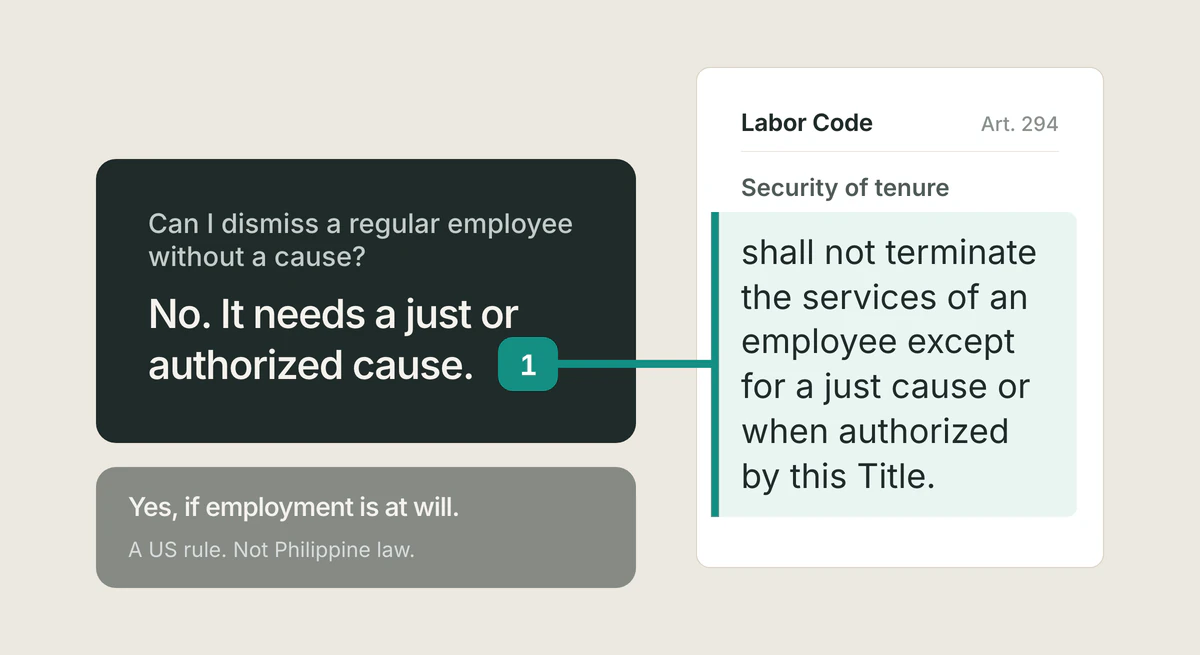
AI legal research tools
GPT-4 hallucinated on 43% of legal queries in Stanford's test, and US legal AI barely covers Philippine law. What actually works for PH legal research, from the SC E-Library to grounded AI.
Read the article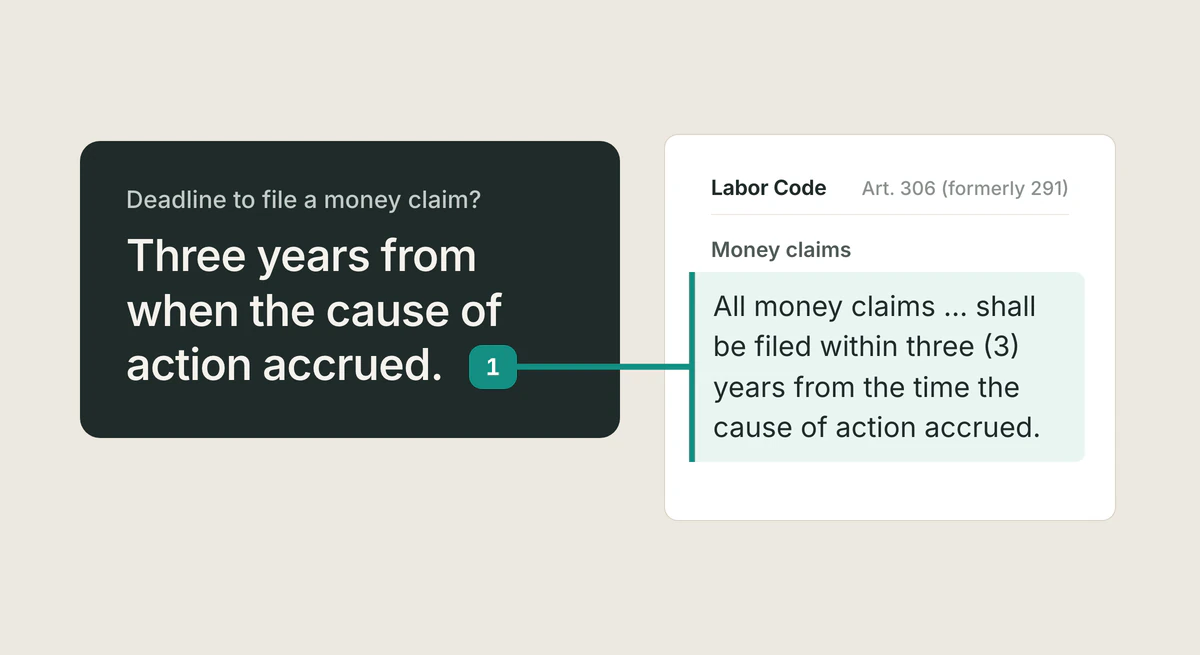
AI Legal Research
Philippine legal research with AI is reliable only when each claim is checked against an official source. Learn how to find, trace, and verify cited law.
Read the article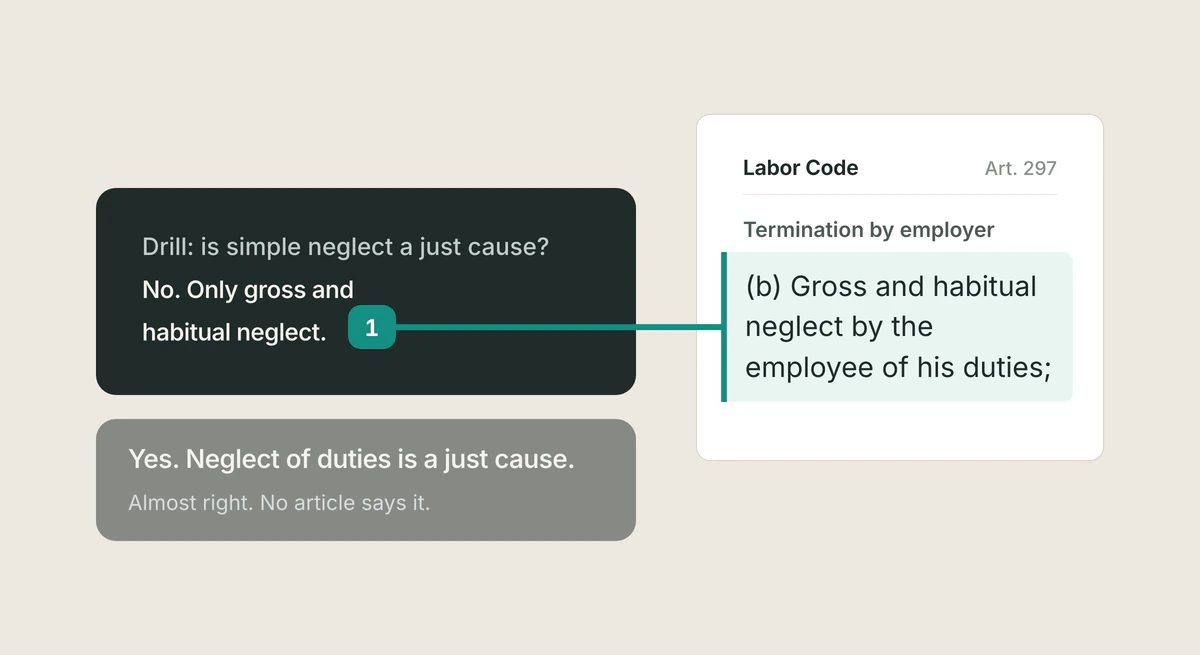
AI for bar exam study
48.98% passed the 2025 Philippine Bar. AI can genuinely help you join them, if you use it as a drill partner grounded in real law instead of a summary machine you cannot check.
Read the article